
Transforming Technical Data into Story and Visuals
Not all organizations doing important work can explain it in a way that moves people. The data might be there. The credibility as well. But the story — the version that makes a stakeholder pause and pay attention — isn't.
That gap is exactly where our work with Leading Harvest lives.
As Peter Miller, who led business development at Leading Harvest, put it:
"I know that the most compelling information tells a story — and we needed help with storytelling. Through the process of working WithJasmine, it actually changed how we talk about the organization. It helped us better understand what we do through the lens of others. It wasn't just the collateral that was produced, our overall articulation of value and pitch improved."
Partnering with Leading Harvest
Leading Harvest is a nonprofit working on farmland sustainability. Their Program Users are some of the world's largest farming operations — and their partners are some of the world's largest food companies. What they do is rigorous and hard to explain to someone who wasn't already looking for it.
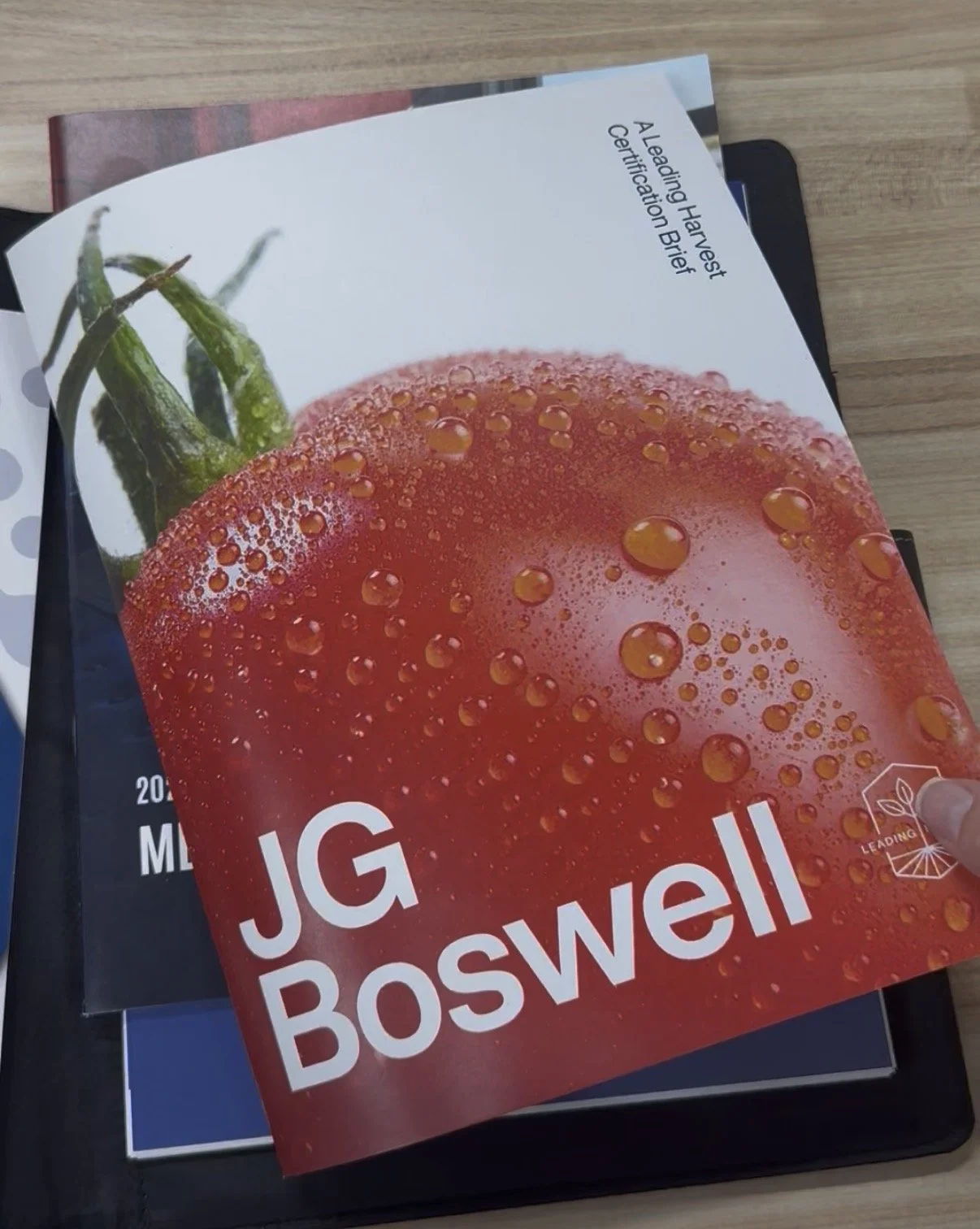
They came to us with an ask that sounded simple: redesign their technical audit reports to become something beautiful and readable — turning each report into a “Farm Stewardship Profile” with sales capacity.
We Changed the Design Brief
Before we touched a layout, we did what we always do — we talked to the people who would actually use it. We ran discovery sessions with Leading Harvest's team and, critically, with Program Users themselves: certified suppliers navigating real procurement conversations with real buyers.
What we heard made us take a sharp turn.
These organizations were trying to have a fundamentally different kind of conversation about Leading Harvest with brands and buyers who had never heard of them. The scope needed to change — the audit report was simply evidence buried inside an untold story, not the problem or the solution.
What Peter noticed about that moment:
"You understood what our goals really were. You understood that maybe what we said we needed wasn't exactly what we needed. But because you understood our business case, you showed us how to get what we needed through a better route."
Narrative Strategy Uncovered What’s Hidden
We ran narrative sessions with Leading Harvest's team to excavate their underlying story — not what the certification covered, but what it meant for a buyer trying to make a sourcing decision in a noisy sustainability landscape.
This set of sessions — with their team, with Program Users, with outside industry expertise — was the process of finding the story that already lived inside everything Leading Harvest was doing, and building the infrastructure to make it legible enough to travel.
What emerged was a clearer picture of the real challenge: Leading Harvest represents a paradigm shift in how agricultural certification works and no one was explaining their innovative thinking.
The process of slowing down to do discovery before production was critical. Peter mentioned:
"That time is really well spent because it ends up saving so much time on the back end. The very first version that you produced was so much more complete and mature than I would have expected for a first draft — and it was because of that investment in the front end."
Visual Appeal is Second to Understanding
Transforming audit data into something credible, readable, and visually compelling takes craft and care. But the more important challenge came earlier — helping an organization see that what they had wasn't a design problem. It was a communication problem.
Leading Harvest had worked with other designers in the past. What was different this time was the depth of our understanding.
"We work in agriculture and there's sort of a typical narrative that a lot of designers follow around sustainability. You guys avoided all of those tropes to understand much more of the actual work and the business case. And by understanding the business case, it helped move beyond those tropes. I was most surprised by how well you understood the complexity of our organization and our work."
Our process resulted in core artifacts that are instrumental in produces purposeful content for Leading Harvest moving forward. Besides the final Farmland Sustainability Profile, we developed:
a content purpose map — a diagnostic that asked, for every piece of information: why does this exist, who is it for, and what should a reader understand, feel, or do after encountering it?
a communications ecosystem map — a systems-level view of where the Farm Stewardship Profile fit within everything else Leading Harvest was producing, and how it would move through the relationship between all stakeholders.
a set of core visualizations — system maps, certification comparisons, impact frameworks — designed not just to live inside the profile but to be extracted. Pulled into a presentation. Shared in a meeting. The story became repeatable, not locked in a PDF.
Ensuring Confidence in Collateral
The Farm Stewardship Profile that came out of this process does several things at once.
It meets the needs of the user. Rather than leading with the certification, the profile leads with the supplier's story — their scale, their practices, their proof points.
It speaks the language of the stakeholder. Every section is written for someone with a sourcing decision to make.
It uses Leading Harvest vernacular. We surfaced the vocabulary that was already earning trust and gave Leading Harvest a way to carry it forward consistently.
The response was immediate. Peter shared an early draft with stakeholders before the project was even finalized:
"I ended up showing an early draft to a few of our stakeholders and they immediately requested copies to use the following week — with some of the world's largest restaurants and food companies."
“WithJasmine will dig in and understand what you want to do better than you can imagine. What they produce is going to be clearer and more valuable than whatever end result you might have in mind."
— Peter Miller, former Director of Supply Chain Engagement, Leading Harvest
WithJasmine.com works with technically expert organizations to make complex ideas legible to the audiences that matter. This engagement was in collaboration with Maps & Mirror.
